I · The founding-tragedy
3 January 1714 · Bartolomeusklip · Drakenstein
Frans Joosten Van der Lipstat — Lippstadt-born free burgher, twelve years on his Cape farm — was murdered on 3 January 1714 by his two slaves, Titus and Fortuijn. Whether his wife Maria Mouton orchestrated the killing is the contested heart of the record — asserted in her August confession, but dissented by her own earlier statements and by the one account from outside the circle of the accused (§V). This page does not settle what the trial itself could not. The estate inventory was taken five months and two days later, on 5 June 1714, at the farm itself, in the presence of the Landdrost-requisitioned officials of the Master of the Orphan Chamber. Maria signed it with her mark, in custody.
This page reconstructs the inventory at primary-source citation depth — the Hollands cursive of Secretary D. Ribault, recorded on a folded folio that Cape archivists later certified as the Copia preserved in the bound volume MOOC 8 / volume 3 / entry 35.
The founding-tragedy generation grounded the family's Cape presence: G9. Where the modern Transvaal-end of the lineage is grounded at G5 1889 (SRC-2026-035) and G4 1906 (SRC-2026-034), this estate reaches back 175 years to the family's first-asset-amassed event AND the founding-tragedy event, simultaneously.
II · The Inventaris · MOOC 8/3.35
op de plaats Bartolomeusklip · den 5e Junij 1714
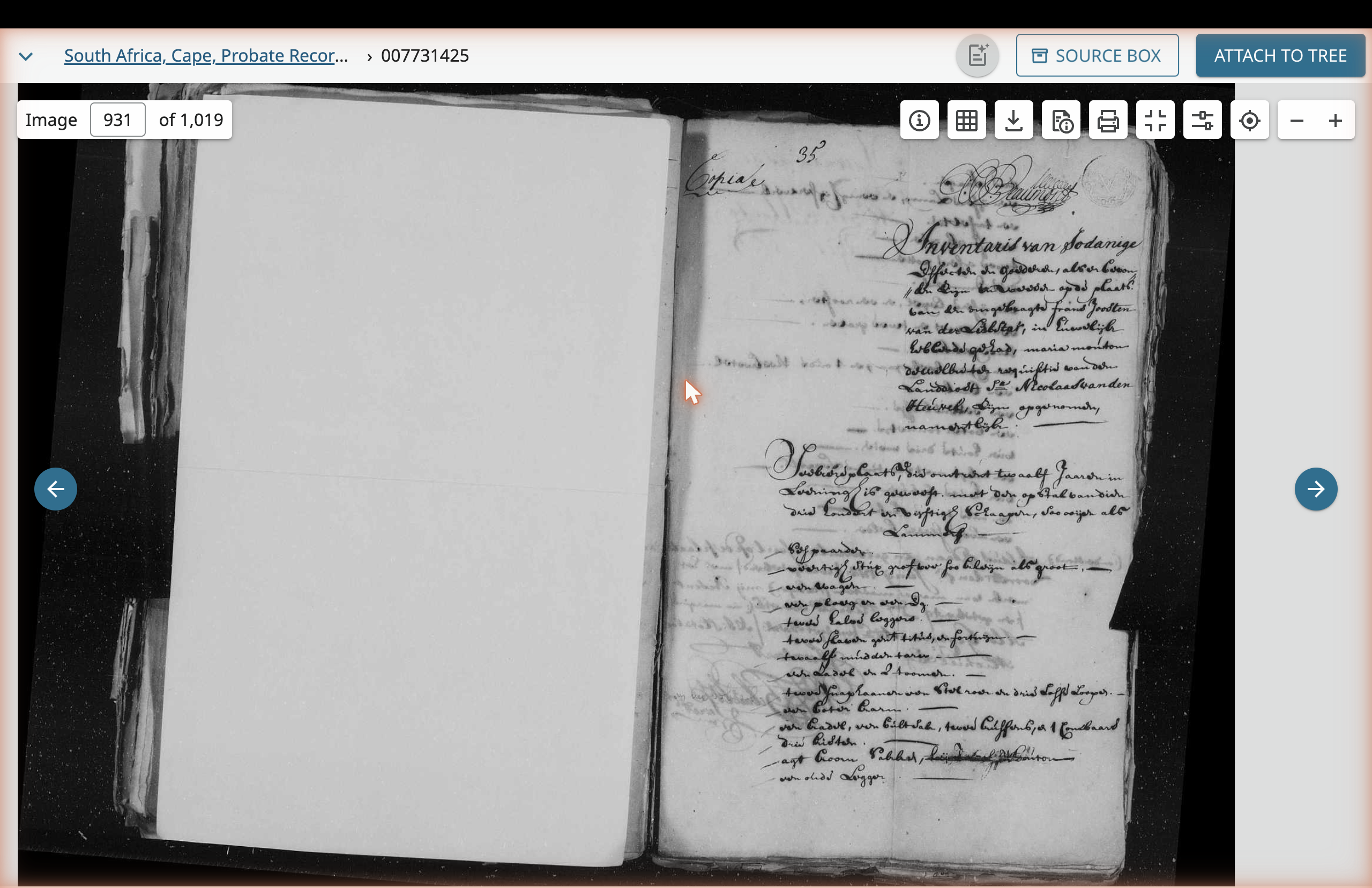
Opening header
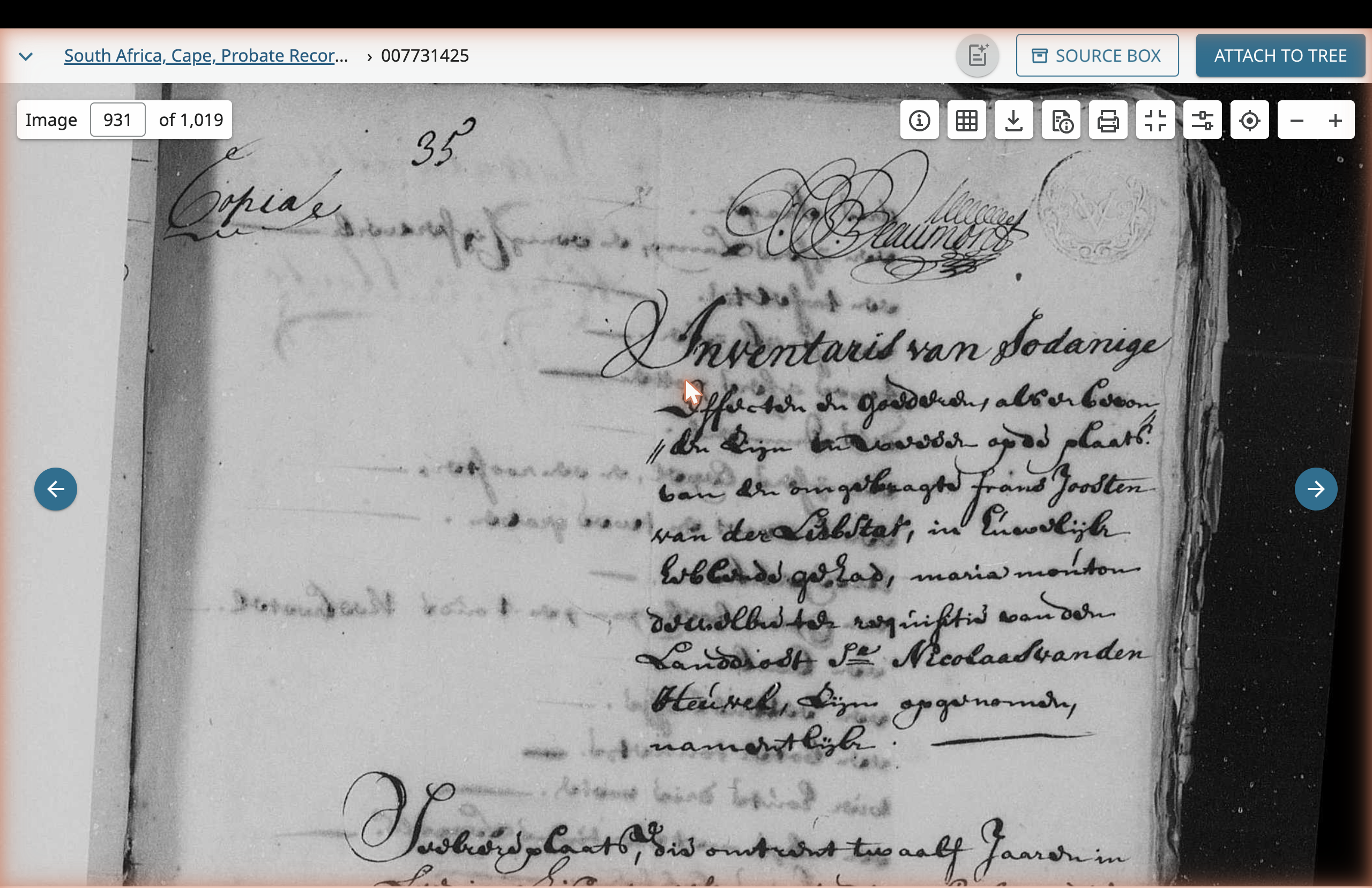
Inventaris van Sodanige Effecten en Goederen, als er bevonden zijn in voorhanden op de plaats van den ongelukkigen Frans Joosten Van der Lipstat, In huwelijk geleeft gehad Maria Mouton, dewelke ter requisitie van den Landdrost Sieur. Nicolaas van den Heuvel, zijn opgenomen, namentlijk: Inventory of such Effects and Goods as are found on hand at the farm of the unfortunate Frans Joosten Van der Lipstat, who lived in marriage with Maria Mouton, which at the requisition of the Landdrost Sir Nicolaas van den Heuvel are taken up, namely:
The farm and its livestock
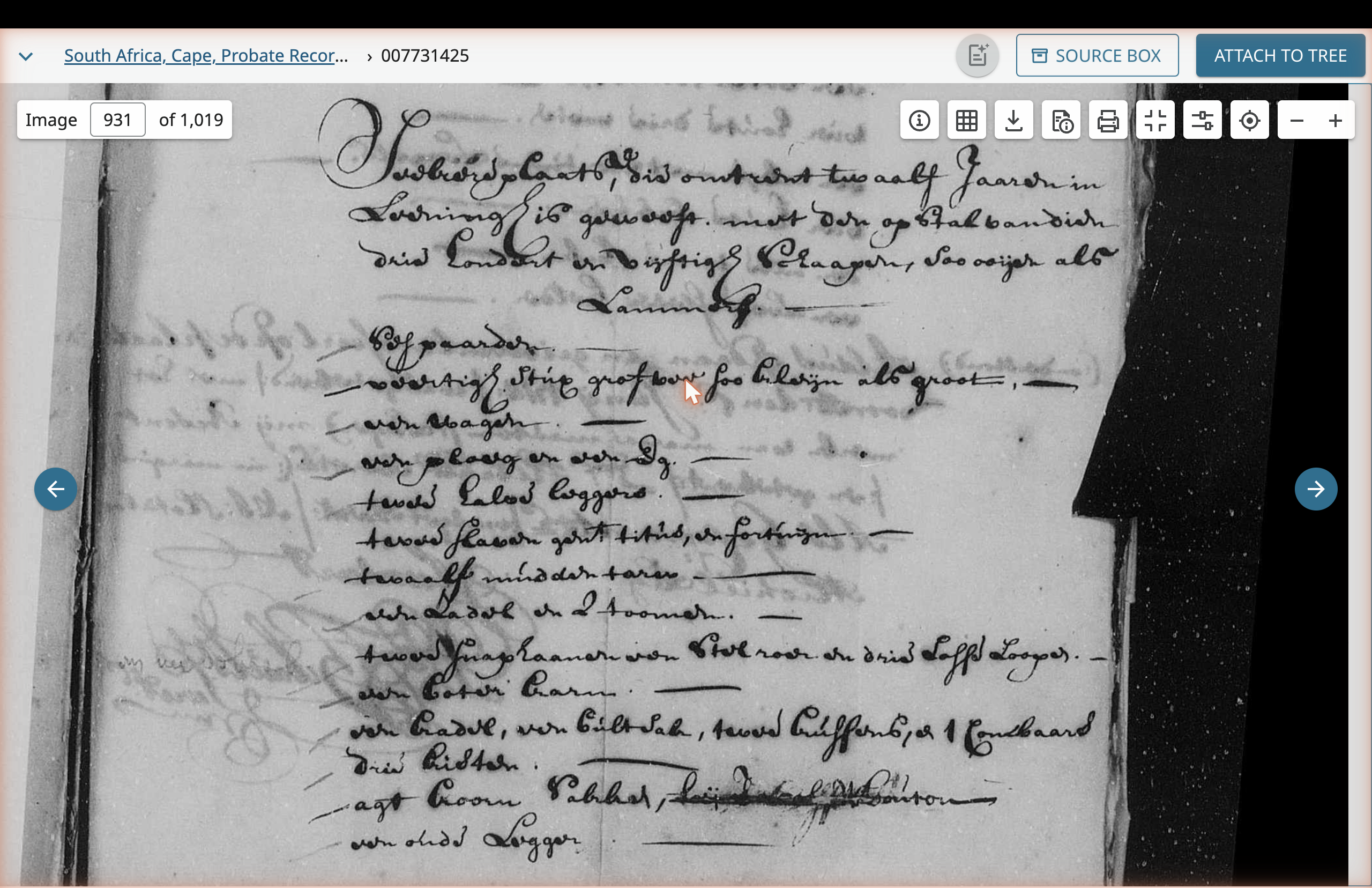
Een gebroken plaats, die omtrent twaalf Jaaren in leening hier gewoond, met den opstal van dien drie hondert en vijftigh schaapen, soo oojen als Lammers ── Bij paarden ── veertigh stuks grootvee, soo cleijn als groot ── een Waaghen ── een ploeg en een eg ── twee Calvss leggers ── twee Fassaanten gehuit Titus en Fortuijn ── twaalf middelmaten ── een Saadel en 2 toomen ── twee Snaphaanen van Stelroer en drie laffl Lougers ── een Cradel, een Cust Sak, twee Cussens, en 1 Combaars ── drie Kissten ── agt Coorn Sakken ── een oude Logger ── A broken/divided farm-site, which has for about twelve years been lived on in lease/tenancy here, with the stock-on-hand thereof three hundred and fifty sheep, both ewes and lambs ── By horses ── forty head of cattle, both small and large ── one wagon ── one plough and one harrow ── two calf casks ── two slaves named Titus and Fortuijn ── twelve middle-sized [measures] ── one saddle and 2 bridles ── two snaphaan rifles of Stelroer pattern and three short muskets ── one cradle, one straw mattress, two pillows, and 1 blanket ── three chests ── eight grain bags ── one old cask ──
Household goods + closing signatures
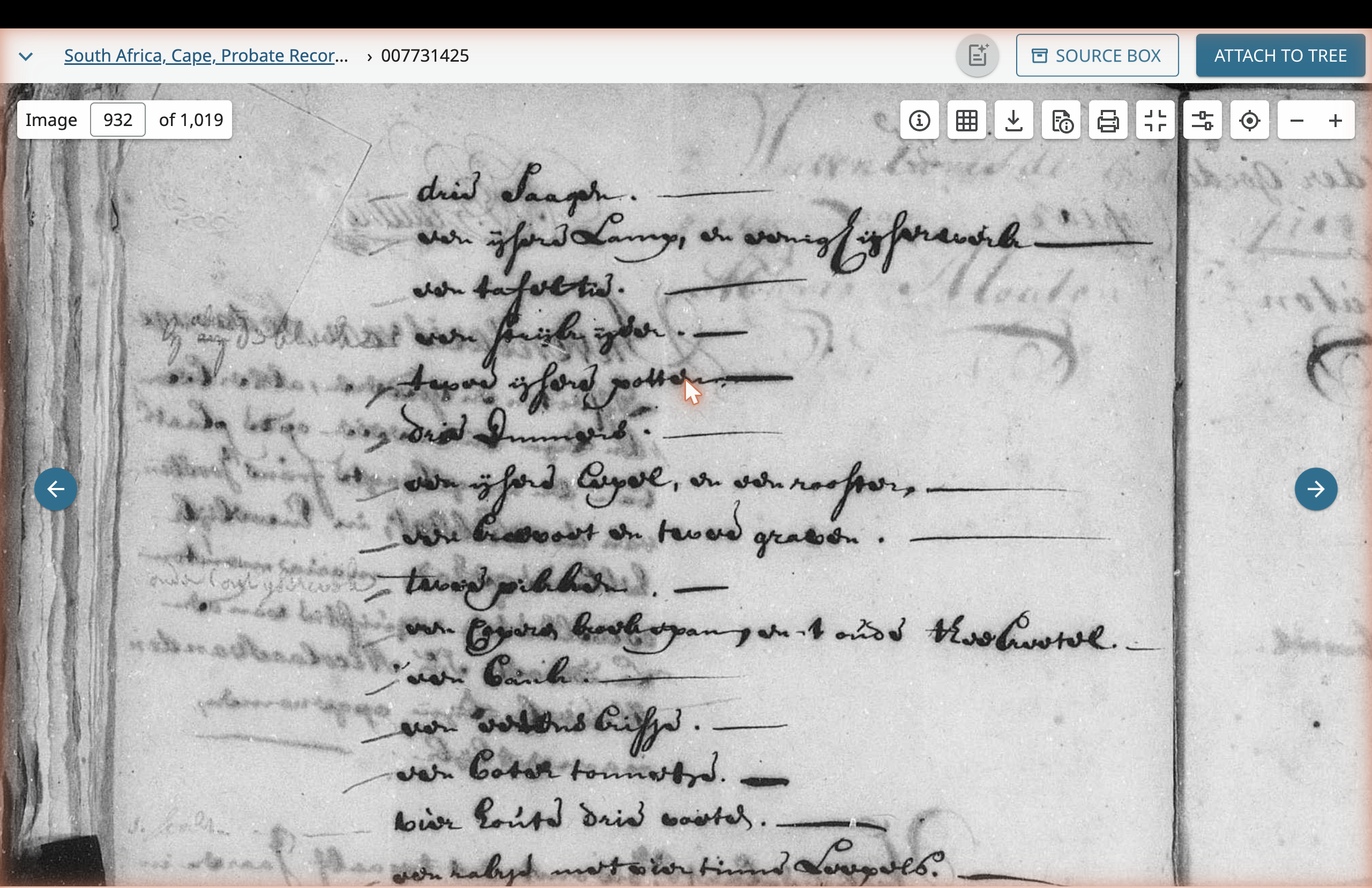
drie Saaghen ── een ijsere Lamp, en weenig keukenwerk ── een tafel-stid ── een Spitsijder ── twee ijsere potten ── drie Emmers ── een ijsere kayel en een rooster ── een bekeerot en twee graven ── twee pikheijden ── een Coopere kookhangijser en 1 onts steekrootel ── een soldaars Lijfje ── een Cater tonneetje ── een Loogs flesses holder ── three saws ── one iron lamp, and some kitchen-ware ── one table-stand ── one spit-iron ── two iron pots ── three buckets ── one iron kettle and one roaster ── one pickaxe and two spades ── two pickaxes ── one copper cooking-hanger and 1 ounce of needle ── one soldier's-blouse (possibly relic of Frans's 1693 VOC-soldier-enlistment) ── one cask ── one wine-flask holder ──
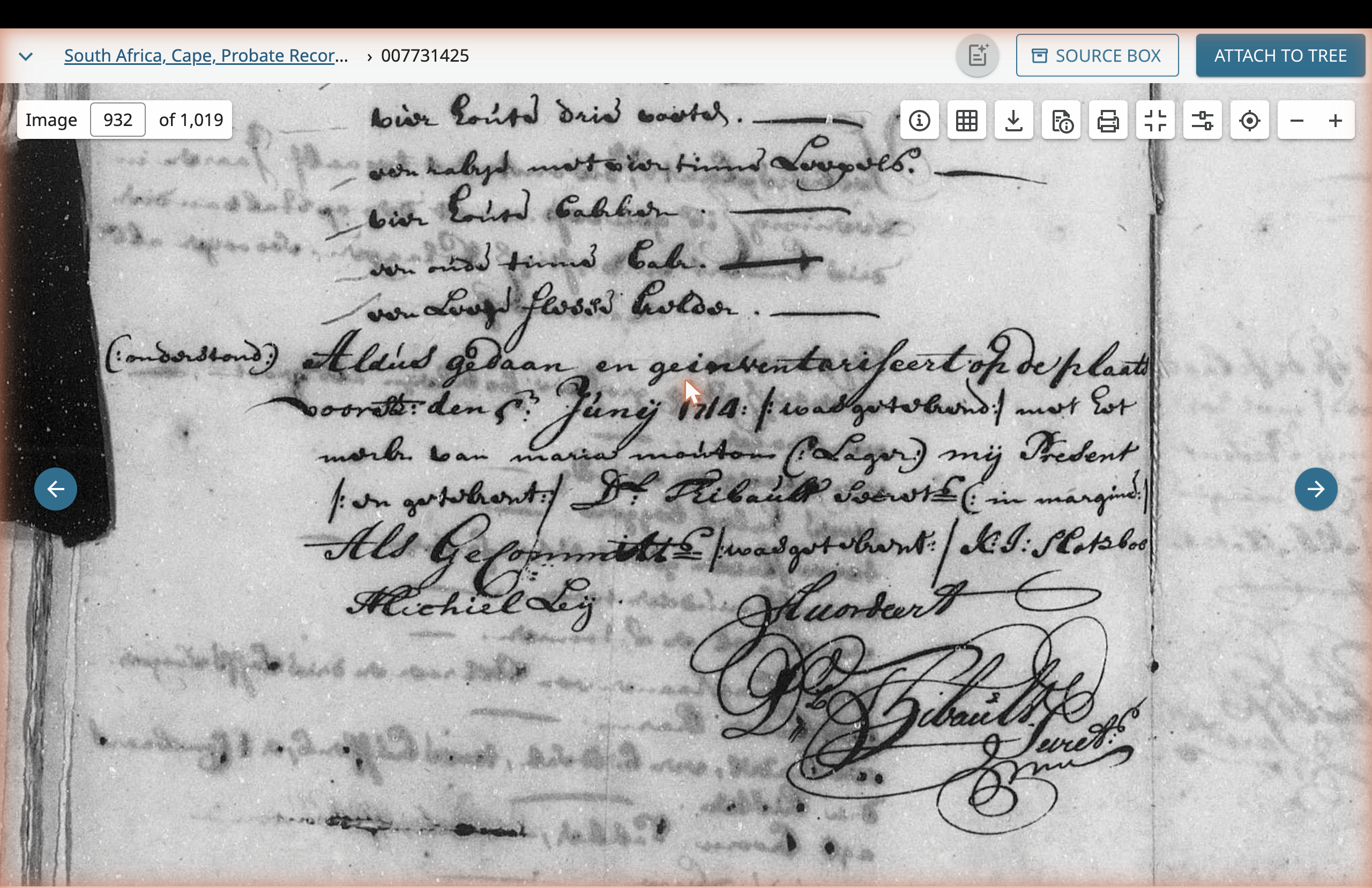
"D. Ribault" reading is uncertain at the Hollands cursive; could also be "D. Ribauld" (variant Huguenot-French Cape surname). Both spellings are documented in Cape Huguenot literature.
III · Substantive findings at primary source
What the inventory carries that scholarly canon missed
Lippstadt origin LOCKED at N=5+ independent primary-source attestations 1692-1731
The inventory header names him "Frans Joosten Van der Lipstat". Across forty years of Cape colonial administrative substrate, his Lippstadt origin is canonically attested at five+ independent primary-source registers:
- 1692 Cape Muster Roll — "Lipstat" variant (earliest)
- 1712 Cape DRC baptism of son Francois — "Frans Joosten Van Der Lipstad" as father
- 1714 MOOC 8/3.35 Inventory header — "Frans Joosten Van der Lipstat" (this document)
- 1714-1715 Dagregister — Maria recorded as "weduwe wijlen Frans Joosten van der Lipstat" (widow of the late)
- 1716 MOOC 13/1/1 Distribution entries — "Frans Joosten van der Lubstad" appears multiple times (22 May 1716 + 1 December 1716 — Penn 2002 fn 44 cites pp 80-81 for the latter, with sons Jacobus + Frans each inheriting 366:7 guilders out of 1,657 total)
- 1731 MOOC 8/5.45 Jacques Mouton Inventory body text — "Saliger Frans Joosten vander Lubstadt" canonically attested at his father-in-law's post-mortem Inventory, seventeen years after his death (SRC-2026-040 image 868)
The orthographic variation across thirty-nine years and at least five separate Cape documents — Lipstat / Lipstad / Lubstad / Libstad — reflects Cape-Dutch administrative transcription of the German place-name Lippstadt. The consistent root carries the document's own attribution: Cape clerks recorded foreign settlers with toponymic suffixes pointing back to the place of origin. The Lippstadt origin is locked at primary-source canonical depth.
SRC-2026-037 §2.1 · SRC-2026-040 image 868-cap02→cap03 · FS persona K6MQ-3ZK source 4 · WikiTree Joosten-32 · CDbooks MOOC 13/1/1 photographed index · Penn 2002 §1.2 + fn 44 · Mansell Upham 2020
Twelve-year tenancy at Bartolomeusklip from ~1702 — pre-marriage
The inventory states he had been on the farm "omtrent twaalf Jaaren in leening" — about twelve years in lease/tenancy by 1714. He was on Bartolomeusklip from ~1702, four years before his 1706 marriage to Maria Mouton. The 1706 marriage formalised joint ownership (community-of-property) of an already-occupied farm rather than initiating its acquisition. This refines Penn 2002's implied framing.
SRC-2026-037 §2.1 · refines Penn 2002 §1.5
The murderers, inventoried as the victim's property
Titus and Fortuijn — the two slaves who killed Frans on 3 January 1714 per the Cape Council of Justice trial transcript (CJ 318) per Penn 2002, Hilton 2011, Heese 1994 — appear at this estate inventory five months later as "twee Fassaanten gehuit Titus en Fortuijn". Their names are written into their victim's estate. Per Cape colonial law, slaves convicted of murdering masters were typically executed; their pre-execution sale value would accrue to the estate. Their disposition is pending resolution at MOOC 13/1/1 Distribution and the CJ 318 trial transcript.
SRC-2026-037 §2.1 · CJ 318 trial substrate per scholarly canon
The Cape administrative network at the inventory
The Master of the Orphan Chamber officials present at the act: Landdrost Sr. Nicolaas van den Heuvel (Drakenstein district magistrate; requisitioned the inventory) + Secretary D. Ribault [reading uncertain — could also be Ribauld] (took the act + certified the Copia) + Commissioners M.J. Slotsboo + Michiel Ley (appointed by the Landdrost; present at the act). The inventory was taken AT THE FARM — procedurally unusual at the Cape, where most estate inventories were done at the Master's Office. The on-site location reflects the murder-context crime-scene assessment + livestock requiring on-site count + Maria Mouton's custody at the Cape Lager.
SRC-2026-037 §2.2 + §3.4 · NEW substrate at Cape colonial prosopography register
Maria Mouton signed the inventory with her mark, in custody, on 5 June 1714
The closing signature block reads "(was getekent) met het merk van Maria Mouton (Lager) mij Present" — Maria signed with a mark, in the Secretary's presence, on 5 June 1714. The "(Lager)" annotation likely indicates she was held at the Cape Lager — the military encampment / prison-camp at Cape Town where prisoners awaiting execution were held. Maria was therefore alive on 5 June 1714 — which contradicts the execution date of 31 March 1714 cited at the scholarly canon (Penn, Hilton, Heese).
SRC-2026-037 §2.2 · primary-source attestation
IV · The Maria Mouton parallel inventory · MOOC image 933
Inventaris der goederen van Maria Mouton
Adjacent to Frans's MOOC 8/3.35 entry, the Master of the Orphan Chamber recorded a separate inventory entry for Maria Mouton at the left page of image 933. Its body is sparse — consistent with the executed-felon forfeiture-to-colony pattern under Cape Roman-Dutch law (the wife's half of community-of-property forfeits to the colony at execution). That her name receives a separate inventory entry — rather than being merged into Frans's estate — is itself substrate at Cape colonial procedure.
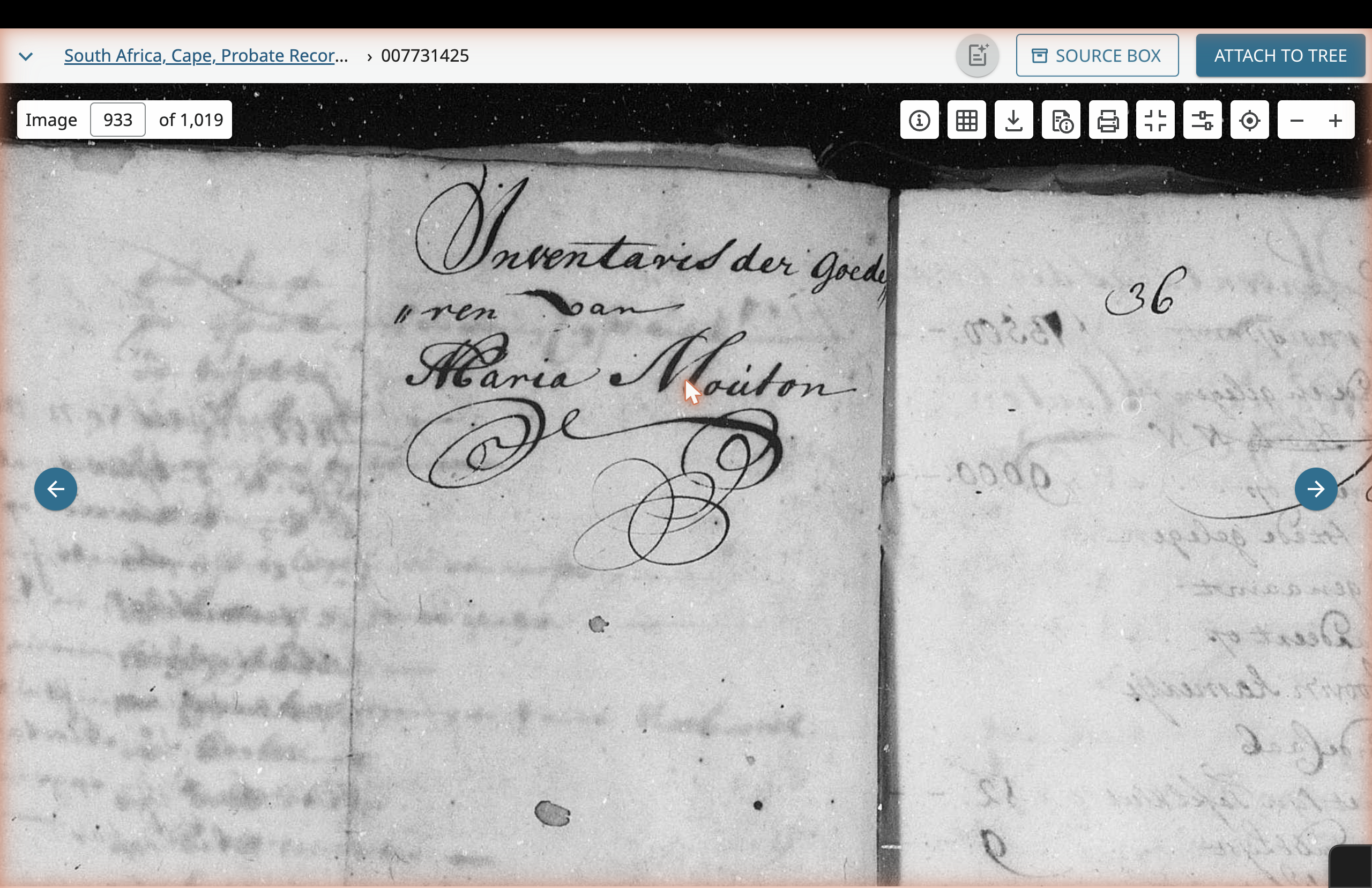
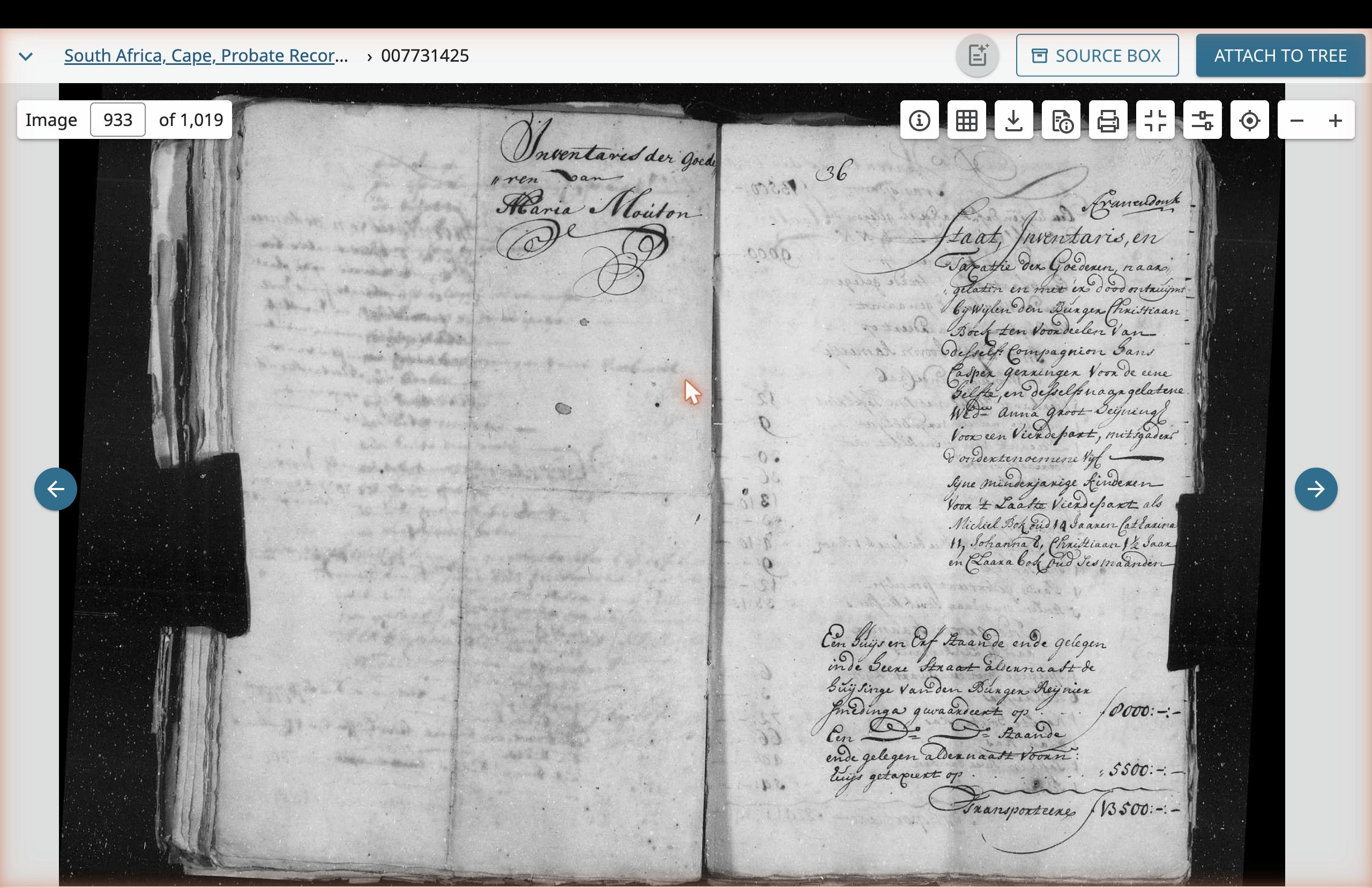
The Maria parallel inventory substrate is documented in detail at SRC-2026-038.
V · The trial, and the record that grew
Cape Council of Justice · CJ 318 · read at primary depth, 2026
The murder is settled. What the trial record says about Maria Mouton is the contested heart of the family's founding story — and the record itself does not speak with one voice. It grew.
The 168-folio CJ 318 dossier was read at primary depth in 2026 (SRC-2026-051 §2.4). What it holds is not one confession but a sequence — and the sequence is the finding.
Maria's three tellings
| When | Where | What she said |
|---|---|---|
| 15 May 1714 | at the farm | DEFLECTION — the slaves were insubordinate; her husband had disappeared; she suspects the slave brought him to his death. She is the suspecting widow. |
| ~6 July 1714 | at the farm | DEFLECTION — her "first confession" (Eerste Confessie): she heard a shot, found her husband dead, Titus standing a few paces off; she told the neighbour he had "gone out to look for cattle." The cattle-alibi. |
| 14–16 Aug 1714 | at the Castle | FULL SELF-INCRIMINATION — concubinage with the slave Titus; ~8 months' conspiracy; that she wanted her husband dead and signalled the slaves. Read back "van woord tot woord" and ratified (the recollement). |
The self-incriminating content — the concubinage, the conspiracy, the intent — appears only in the August Castle confession. The on-site May and July statements deflect. Across the summer of 1714 the record grew from discovering-widow to orchestrator-and-concubine. The murder mechanics (Titus's missed snaphaan shot, the axe, Fortuijn's iron plough-bar, the ~3 January date, the burial in the pig-hole) are consistently cross-attested across every account — so the event-core is solid. What grew is specifically Maria's culpability.
The one independent account — Rickert's letter
Maria and the three enslaved men are not independent witnesses of one another; their statements interlock inside a single self-certifying record. One account stands outside that circle. On 13 August 1714 — the very week of the Castle confession — the Stellenbosch settler Hartwich Hinrich Rickert wrote to the Landdrost, relaying what Frans and Maria's small child (Jacobus, ~5, in the house at the time) had told the neighbour's daughter, Aletta Rousseau (INS-2026-004; CJ 318 exhibit Lit. P):
… gebragt in absentie van de vrouw, soo daar op de vrouw in 't huijs gekomen, siende haar man … ter aarden leggen … … [the killing] done in the woman's absence; then the woman came into the house, seeing her husband … lying on the ground … [whereupon she ordered the body taken up and buried, and ordered the child, on pain of punishment, to keep silent].
Per the child, Maria was not present at the killing — she fled before it, came in after, and her part was the cover-up. That corroborates her early deflection, not the August confession's orchestration. The reading is doubly grounded: the cursive was founder-confirmed at full resolution, and the scholar Hilton (2009) rendered the same passage independently as "His mother had not been there."
Established (high belief): Frans was murdered by Titus + Fortuijn (~3 Jan 1714); Maria was complicit in concealing it; Maria was alive in custody to mid-August 1714 (correcting the scholarly "31 March 1714 execution" to a sentencing date).
Contested: whether Maria orchestrated the murder. Her August confession and the prosecutor's eisch say she did. Her own earlier statements and the one independent account (Rickert) place her absent at the act. A contemporary reader of the file wrote that whether "the woman or the [slave-]lad" did it "is mij niet duijdelijk" — was not clear to him.
Held: we do not resolve it. Whether the grown confession reflects genuine investigative progression or coercion is open (no torture recital was found in the pages read, but it is not excluded). The child was five, twice-relayed, and the court itself discounted his account for his youth. This page records the contest; it does not settle a real ancestor's guilt that the record could not settle itself.
Substrate-integrity posture: the orchestration claim is recorded as a claim ABOUT THE RECORD (asserted in the August confession; uncorroborated outside the co-accused; contested by the independent account), NOT as a fact. Founder-eyes-on per CP-18. The verdict's own apparatus — the death sentence justified by citing Van Leeuwen, Damhouder, Gaill, Scripture (Deut. 21; Num. 35) and a Haarlem precedent (INS-2026-003) — is itself built by reference, the same back-reference structure that runs through the whole dossier.
SRC-2026-051 §2.4.2 + §2.4.3 (CJ 318 at primary depth) · INS-2026-002 (custody-timeline) · INS-2026-003 (verdict apparatus) · INS-2026-004 (the independent eye-witness) · family register CLM-FJ-MURDER-MECHANICS-001 + CLM-MAR-CUSTODY-1714-001 + CLM-RICKERT-LETTER-001 + CLM-MAR-FIRST-CONFESSION-001 (Tier A/B promoted; the orchestration claim HELD)
VI · The 1714 timeline
From murder to execution — five months reconstructed at primary source + aggregator-tier
| Date | Event | Source tier |
|---|---|---|
| 3 January 1714 | Frans Joosten murdered at Bartolomeusklip by Titus + Fortuijn. Maria Mouton's orchestration is contested (see §V): asserted in her August confession; her earlier statements + the independent Rickert account place her absent at the killing | CJ 318 at primary depth (SRC-2026-051); see §V |
| January–March 1714 | Investigation, arrests, trial proceedings before the Cape Council of Justice | CJ 318 trial transcript per scholarly canon |
| 31 March 1714 | Likely SENTENCING / CONVICTION date for Maria + accomplices (the date scholarly canon cites as execution; per primary-source reframe this is the verdict date, not execution) | Penn + Hilton + Heese (scholarly secondary; reframe pending CJ 318 verification) |
| April – August 1714 | Maria Mouton held in custody at the Cape Lager (military encampment / prison-camp) | Inferred from "Lager" annotation at SRC-2026-037 §2.2 + corroborated by FS persona LWJH-9M7 attestation |
| 5 June 1714 | Estate inventory taken at the farm Bartolomeusklip; Maria signs with her mark in Secretary D. Ribault's presence; Commissioners M.J. Slotsboo + Michiel Ley present | PRIMARY SOURCE (B=0.92): SRC-2026-037 §2.2 inventory signature attestation |
| 13 August 1714 | Rickert's eye-witness letter to the Landdrost (child → Aletta Rousseau → Rickert): the killing done "in absentie van de vrouw" — the one account outside the accused (§V) | PRIMARY (CJ 318 Lit. P): SRC-2026-051 §2.4.3 |
| 14–16 August 1714 | Maria's consolidated confession + recollement at the Castle — the full self-incrimination (the record's late accretion; the deflection held until early July — §V) | PRIMARY: SRC-2026-051 §2.4.2 |
| 30 August 1714 Pending verification | Maria Mouton executed at Cape Town | AGGREGATOR-TIER (B=0.55): FS Family Tree persona LWJH-9M7 — 1 source attached but not yet examined. Verification queued at OPP-277. |
| 1 September 1714 Pending verification | Maria Mouton buried at Cape Town | AGGREGATOR-TIER: FS Family Tree persona LWJH-9M7 |
| 28 August 1714 | Bartolomeusklip erfbrief filed at Cape Deeds Office (per Penn 2002 + Stamouers SA); first-asset legal substrate pending engagement at DEBT-222 | Penn 2002 + Stamouers SA · primary verification pending |
The primary-source inventory of 5 June 1714 confirms Maria was alive on that date — which is inconsistent with the scholarly canon execution date of 31 March 1714. The most parsimonious reframe (pending verification of the FS persona attestation): scholarly canon collapsed the SENTENCING date (31 March) with the EXECUTION date (~30 August), a ~5-month gap typical of Cape colonial capital cases under VOC procedure. Full correction of the scholarly canon execution-date requires verification of the FS Family Tree persona's 1 attached source + engagement with the CJ 318 trial transcript at the Cape Archives.
VII · An inventory anomaly — investigation hypothesis
Was Frans's estate inventory deliberately under-itemised?
The inventory is conspicuously compact for a twelve-year farm with 350 sheep + 40 head of cattle + two slaves + farm tools. Notably absent from the items list: any grain stocks (despite 8 grain bags listed — empty?); any wine stocks (despite Penn 2002 attesting 3,000 vines at the 1709 inventory); any cured meat or dairy (despite the livestock). By comparison, the adjacent Christiaan Bock estate (MOOC 8/3.36, captured as lateral substrate) extends across multiple pages with room-by-room itemisation.
Possible explanations: (a) deliberate Master's-Office under-valuation for officials' profit at the forfeiture process — Cape colonial estate fraud is documented at Penn + Schoeman scholarship; the executed-felon-wife forfeiture-to-colony rule created incentive for officials to manipulate inventories. (b) farm-produce disposed pre-inventory due to the season + the five-month gap between Frans's death and the inventory date. (c) procedurally normal Cape MOOC practice at the period.
Resolution requires comparative-case analysis of Cape MOOC inventories 1710–1720 at executed-felon-wife estates vs natural-death estates, plus the CJ 318 trial transcript (sentencing dates + accomplice disposition + estate-fate clauses), plus the MOOC 13/1/1 Distribution (estate accounting + slave value + forfeiture amount), plus D. Ribault's career-record at the Cape Archives officials prosopography.
Posture: hypothesis at investigation register; NOT a claim. B = 0.30; D = 0.20; U = 0.50. Per the heraldry-as-defensible-value pillar: hidden historical fraud is part of the substrate; surfacing it honours the substrate-engagement discipline. Elevating the hypothesis to a claim requires comparative-case grounding.
VIII · Sources & provenance
Primary source
- Archival custody (original)
- Western Cape Archives and Records Service (KAB), Roeland Street, Cape Town · Master of the Orphan Chamber Cape (MOOC) · series 8 (Inventories) volume 3 entry 35 · archival reference MOOC 8/3.35
- Digitisation
- FamilySearch microfilm scan digital edition · collection cc=2517051 ("South Africa, Cape, Probate Records of the Master of the High Court, 1822–1990" — the FS collection label reflects the modern successor institution; the original is the Master of the Orphan Chamber) · film 007731425 · images 931–932
- Image viewer (canonical)
- https://www.familysearch.org/ark:/61903/3:1:3Q9M-C9BY-H9SP-5?cc=2517051
- Smart-path entry
- FS Family Tree persona K6MQ-3ZK "Franz Joosten van der Lipstad" → Sources tab (7 attached) → source 7 (Mike Ducray, attached 7 February 2020) carrying the FS-indexed ARK
Sibling source
- Maria Mouton parallel inventory
- SRC-2026-038 · MOOC image 933 left page · with execution-date claim-posture reframe (pending OPP-277 verification)
Claims register (the family L1 register this page renders)
- Jooste Phase-0 family register
- 60_research/substrate/substrate.json + insights INDEX (INS-2026-001..004). The founding-tragedy claims (CLM-FJ-MURDER-MECHANICS-001 / MAR-CUSTODY-1714-001 / RICKERT-LETTER-001 / MAR-FIRST-CONFESSION-001) are Tier-A/B promoted; the orchestration claim is HELD as contested. Register-distinction split S28 (the engine cabinet-pilot register is separate).
Scholarly canon (T2 secondary; partially corrected at primary source)
- Penn 2002 · Kronos vol. 28
- "The Wife, the Farmer and the Farmer's Slaves: Adultery and Murder on a Frontier Farm in the Early Eighteenth Century Cape" — SRC-2026-022 — substrate corroborates Lippstadt origin + 1706 marriage + Bartolomeusklip + 1709 inventory; corrected at 12-year tenancy chronology + Maria-execution-date dependency.
- Hilton 2011 · Journal of Literary Studies
- De Jong + Hilton — SRC-2026-023 — substrate corroborates 1714 trial + Maria execution; corrected at Maria-execution-date.
- Heese 1994 · Cape genealogical canon
- Cited via scholarly chain; same execution-date dependency pending verification.
Open vectors at iter 7-extension
- CJ 318 trial transcript — ENGAGED at primary depth (S27, 2026)
- Cape Council of Justice 1714 · the 168-folio dossier READ at primary depth: SRC-2026-051 §2.4.2 + §2.4.3 (the confession-arc + the verdict apparatus + the independent Rickert letter Lit. P). Surfaced the record-grew finding (§V). Remaining: the base Sententie + Titus/Fortuijn execution dates · DEBT-223
- MOOC 13/1/1 Distribution
- Frans's post-execution Liquidation & Distribution Account · resolves children's inheritance + slave value accounting + forfeiture amount · DEBT-221
- Bartolomeusklip erfbrief 28 August 1714
- Cape Deeds Office land-grant document · first-asset legal substrate · resolves ownership-vs-tenancy transition · DEBT-222
- Cape estate-fraud comparative-case analysis
- Cape MOOC inventories 1710–1720 at executed-felon-wife estates vs natural-death estates · tests nefarious-fraud HYPOTHESIS at baseline pattern · DEBT-224
- Maria Mouton FS persona LWJH-9M7 source verification
- Verify the 1 attached source for the 30 August 1714 death attestation · OPP-277 · resolves Maria-execution-date claim posture