In the Estate of the Late · No. 4602/89

Willem Johannes Jooste Sr

30 May 1828 — 5 May 1889

A reconstruction of the Master of the Supreme Court of the Transvaal file for the deceased estate of Willem Johannes Jooste of Potchefstroom in the South African Republic — a Particulier, propertied investor, who held a diversified estate of farms across the Potchefstroom and Klerksdorp districts, shares in the Potchefstroom Mining-Syndicate and four sister companies, and a network of lending instruments and receivables across the Potchefstroom commercial community. The file is twenty pages of Hollands handwritten instruments — Death Notice, Joint Will at Worcester, Inventory, two L&D Accounts spanning nineteen months, Power of Attorney, Weeskamer Remarriage Permission Certificate, and an unusual duplicate Will copy bound in.

Filed at
Master of the Supreme Court of the Transvaal
Custody
TAB Transvaal Archives Depot
Collection
Transvaal Probate Records 1869–1961
File reference
Vol. 007805276 Item 5
FamilySearch ARK
3:1:3Q9M-CS92-69G6-7
Estate value
£11,583 11s 3d (Final L&D)

I · The Instruments

Eight instruments, nineteen months, two governments

The file gathers every instrument the Master's Office processed for G5's estate between the Sterfkennisgewing of May 1889 and the Final L&D Account close in December 1890. Two governments touch the file: the South African Republic (Z.A. Republiek) administered the estate through its Master's office at Pretoria; the Cape of Good Hope Master's seat at Worcester registered the underlying Joint Will (No. 472). Nineteen months of administration is exceptionally rapid for a Transvaal probate of this size — a signal that the widow's remarriage trigger in the Will was activated. The Weeskamer Remarriage Permission Certificate of 17 December 1890 confirms it: F. J. Joost geboren Carr remarried into the Geldenhuys family twelve days before the Final L&D Account closed.

Instrument I
Death Notice
Sterfkennisgewing · Potchefstroom, 5 May 1889 · Image 872
Instrument II
Joint Will
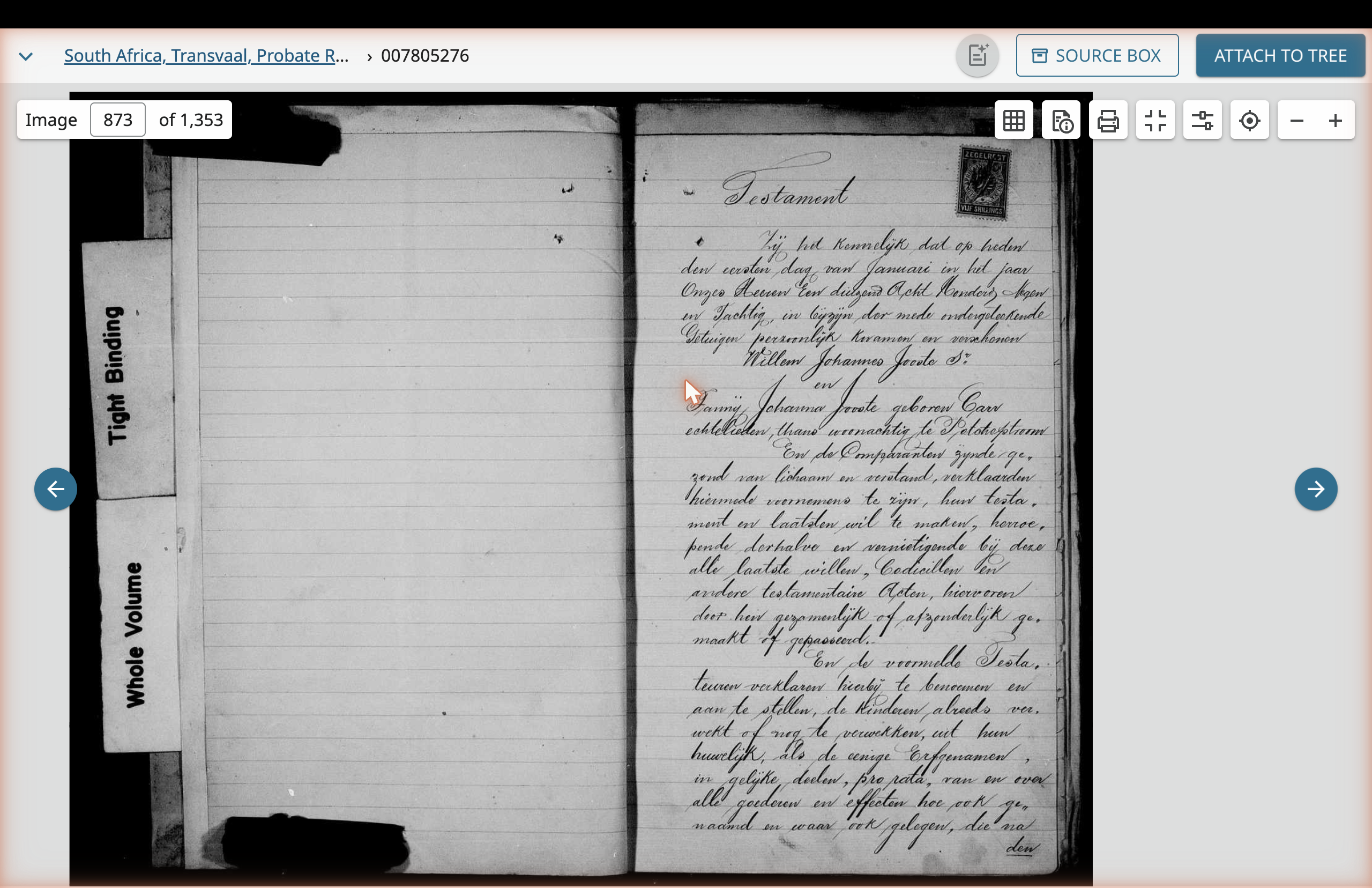
Testament · Worcester No. 472 · 1 January 1889 · Images 873–877
Instrument III
Inventaris
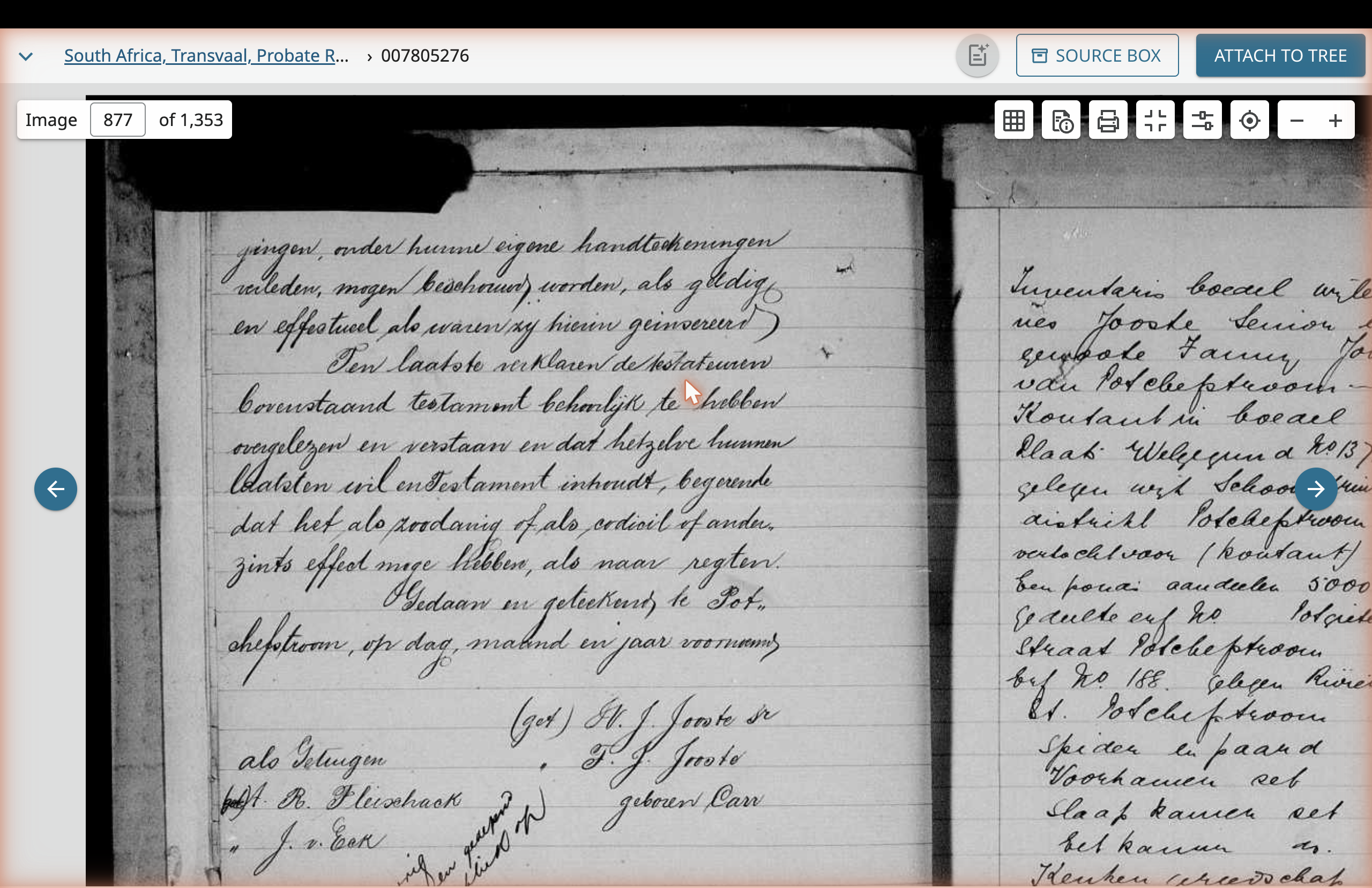
Estate Inventory · Potchefstroom, 14 May 1889 · Image 877 right
Instrument IV
First L&D Account
Eerste Likwidatie en Distribusie Rekening · 26 October 1889 · Images 878–880
Instrument V
Final L&D Account
Likwidatie en Distribusie Rekening · 29 December 1890 · Image 881
Instrument VI
Power of Attorney
Algemene Volmacht · 5 June 1889 · Image 882
Instrument VII
Remarriage Permission
Weeskamer Z.A.R. Certificate · Pretoria 17 December 1890 · Image 883
Instrument VIII
Duplicate Will + Supplementary
Notary-attested duplicate of the Worcester Will + 1907 Erf No. 123 sale · Images 884–890

A note on the languages

The principal instruments — Sterfkennisgewing, Testament, Inventaris, both L&D Accounts, Power of Attorney, Weeskamer Certificate, and the duplicate Will — are written in Hollands, the formal Dutch legal language that served both the Cape Colony and the South African Republic into the early twentieth century. The handwriting is dense Cape-Dutch cursive of the 1880s, with the characteristic loose d/t alternation that turns the family name across Joost, Joosde, Joosten, and Jooste in the same document. The only English text in the file is the typewritten 1907 supplementary instrument concerning the sale of Erf No. 123 — a later post-Anglo-Boer-War addition by the executors.

II · Instrument I — The Sterfkennisgewing

Potchefstroom · 5 May 1889
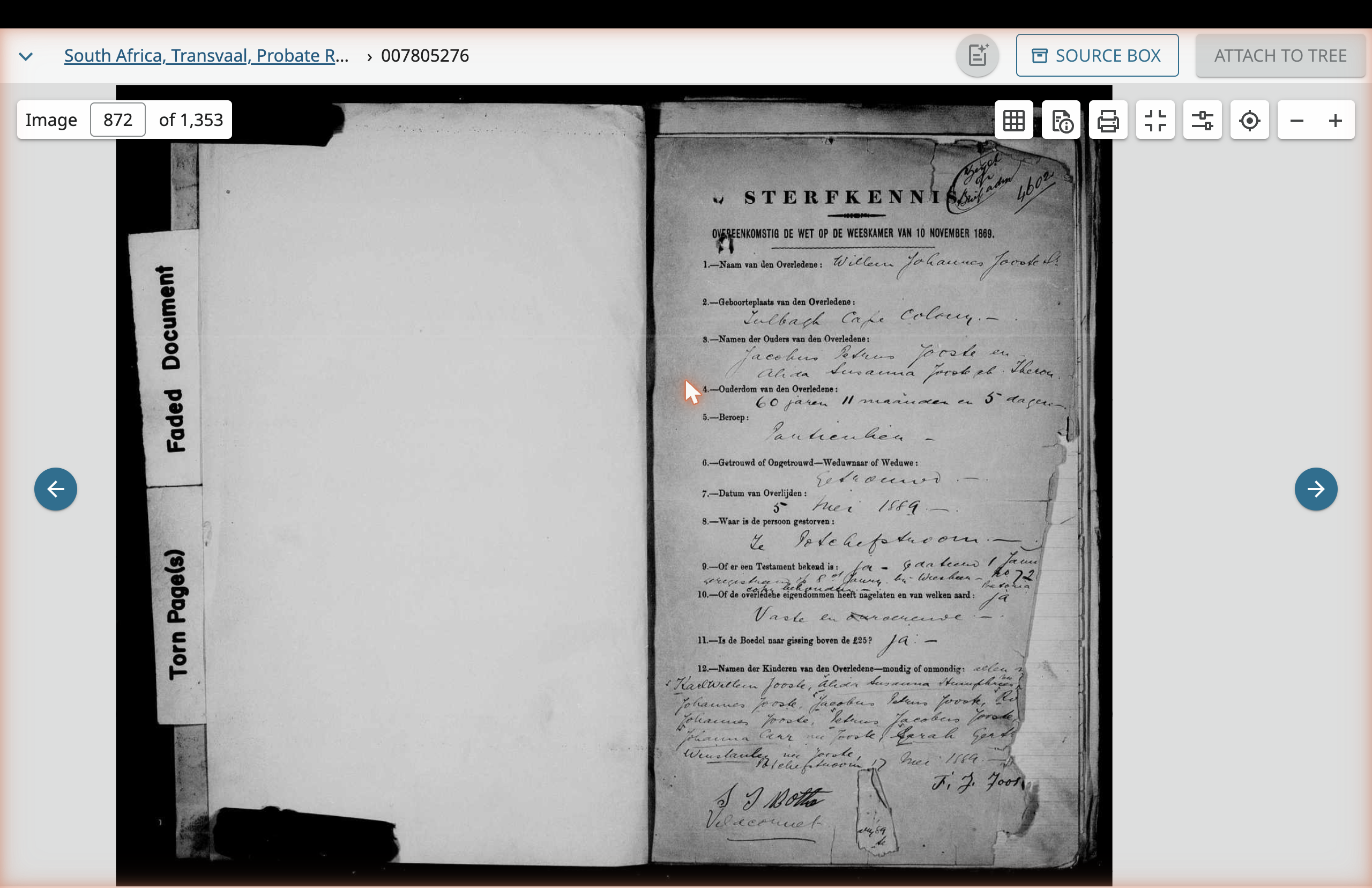
The Sterfkennisgewing for Willem Johannes Jooste Sr, image 872 of the file. The printed Death Notice form completed two days after the deceased's death by his widow Frances Johanna Carr.
Image 872 The Sterfkennisgewing (Death Notice). The printed form is the standard Master of the Supreme Court of the Transvaal Death Notice; the handwritten responses fill in the field-by-field biographical record.

The Sterfkennisgewing names Willem Johannes Jooste Sr in the deceased field, born at Tulbach, Cape Colonie, of the parents Jacobus Petrus Jooste and Alida Susanna Theron. He was 60 years 11 months 5 days at death — a precise figure typical of Cape-Dutch sterftekennis writing. His occupation, in field 5: Particulier. His marital state: married, in community of property, to Frances Johanna Carr. He died at Potchefstroom on 5 May 1889 of natural causes after a brief illness.

The Death Notice carries a critical correction to the xlsx-tradition reading of his parents. Family tradition recorded G6 as "Pieter Cornelis Jooste, born c. 1789 Tulbagh" + "Martha Elizabeth Visser". The primary source contradicts both. The 1889 Sterfkennisgewing in his widow's hand confirms G6 as Jacobus Petrus Jooste + Alida Susanna Theron — the WikiTree Jooste-692 ancestors-page rendering. The xlsx Pieter Cornelis 1788 entry remains undisposed — possibly an alternate-line ancestor; possibly a transcription error from an earlier source.

Particulier — what it meant

At the South African Republic register, Particulier indicates a propertied-investor classification: someone whose primary identity at law was as the holder of capital — land, shares, debts owed — rather than as an active labourer or farmer. The Inventaris and L&D Accounts that follow corroborate the classification beyond any doubt. G5 held five farms across the Potchefstroom and Klerksdorp districts, 2,500 shares in the Potchefstroom Mining-Syndicate at a peak-rush 11/- per share, additional holdings in four sister mining and steam companies, and a lending portfolio that recorded promissory notes and bonds owed to him by neighbours and relatives across the Vaalrivier corridor. He had transitioned, in his own lifetime, from the farmer ancestry of G6–G9 into the propertied class.

The 8 children

The Sterfkennisgewing's field 12 lists the surviving family. Eight children survive G5 at his death:
Eldest Son
Willem Johannes Jooste Jr (G4)
b. 2 May 1856 · m. Elizabeth Magdalena [Humphries?] · The next generation's principal heir; named co-executor with widow Fanny; will himself die at Braamfontein 1906 with his own MHG file at SRC-2026-034.
Son
Carl Willem Joost
Cape-Dutch first-son naming convention preserved at the second-son position; co-buyer of Rietfontein No. 632 1888.
Son
Jacobus Petrus Joost
Named for paternal grandfather (G6); appears as Fanny's co-attorney at the 5 June 1889 Power of Attorney.
Son
Robert Johannes Joost
Earlier readings had this name as "Roland"; the 29 December 1890 Distribution clarifies "Robert".
Son
Pieter Jacobus Joost
Co-buyer of Rietfontein No. 632 1888; Cape-Dutch double-name preservation pattern.
Daughter
Alida Susanna Humphries (geb. Joost)
Married into the Humphries family; her son John William Humphries Jr is named beneficiary of a £1,000 grandchild bequest with G4 as trustee. The Humphries marriage carries a divorce/death alternative clause: if her marriage ends, her Rietfontein share reverts to siblings and she receives a £100-per-year annuity.
Daughter
Susanna Johanna Carr (geb. Joost)
Married Carel Johannes Carr (possibly Fanny's brother); after Carel's death she remarried Jan Gysbert Carr. Carr-family-Joost-family integration was substantial at the G5 generation.
Daughter
Sarah Gertruida Winstanley (geb. Joost)
Earlier readings had this name as "Wessels"; the 29 December 1890 Distribution and the 1907 supplementary instrument both clarify "Winstanley". A granddaughter "Alida Gertruida Winstanley" appears in later records — likely Sarah Gertruida's daughter.

III · Instrument II — The Testament

Worcester No. 472 · 1 January 1889

The Testament opening, image 873. The handwritten Joint Will of Willem Johannes Joost Sr and Fanny Johanna Joost geb. Carr, executed at Worcester, Cape of Good Hope, on 1 January 1889 — five months before G5's death.
Image 873 The Testament's opening recital. The Joint Will is dated 1 January 1889, four months and four days before G5's death — likely written in the knowledge of approaching illness, since G5 was already establishing executor structures, naming Fanny as universal heir, and setting up the £1,000 trust for his Humphries grandchild.

Worcester — the Cape-side legal anchor

The Joint Will is registered at Worcester No. 472, in the Cape of Good Hope. The same Worcester anchor appears at G4's 1906 estate — his Joint Will with Elizabeth Magdalena was also signed at Worcester in the 1880s. This is a multi-generation Cape-side legal-seat pattern that persisted across the family's Cape→Transvaal migration. Possible explanations: a family attorney in Worcester served the extended family across generations; or the family retained Cape-side property (perhaps inherited from G6's Land van Waveren holdings, near Worcester) that required Cape Master's office handling; or the Mouton family (Maria Mouton, wife of G9 Frans Joosten in 1706, was Cape-Huguenot) had attorney connections at Worcester that the Joost-Mouton extended family continued to use. Closing the Worcester anchor question is research opportunity OPP-265 in the project's pipeline.

The structure of the Will

The Joint Will has five distinct sections, each captured at a different image:

§1 · Image 873 · Opening + Universal Heir
The Will recites the testators ("Willem Johannes Joost Sr en Fanny Johanna Joost gebooren Carr, echtelieden thans woonachtig te Potchefstroom") and establishes the longstlevende — the survivor — as universal heir of the entire estate. Cape-Dutch community-of-property convention applies: the joint estate already represents both spouses' contributions; the survivor inherits the whole subject to the children's testamentary rights specified in later clauses.
§2 · Image 874 · Survivor's Possession + Executor Appointment
The survivor retains full possession and use of the joint estate during her or his lifetime, free of the duty to render account to the children — except in case of remarriage. If the survivor remarries, the estate is to be divided "volgens wet" (according to law) at that point. This is the remarriage-trigger clause that activates at Fanny's December 1890 Geldenhuys marriage. The widow is named Executrix; G4 (Willem Johannes Joost Jr) is named co-executor by implication of his Power of Attorney role.
§3 · Image 875 · The 9-Share Supplementary Clause
"...elk een negende aandeel daar uit zullen trekken" — each draws one-ninth. The 9 shares apply not to the main estate (which is divided community-half plus 8-way among children at Cape-Dutch convention) but to ancillary supplementary rights: the mineral rights, the mining-syndicate dividends, share-income from the four sister companies, ongoing rentals, and royalty streams. These continue as a permanent 9-share entitlement from 1 January 1889 onward — the widow taking one share, each of the eight children one share. Some early agent readings of the clause inferred a widow's-double-share for the main estate; the primary-source Distribution math at images 879–881 falsified that inference. The 9-share is for supplementary rights only.
§4 · Image 876 · Rietfontein Recital + £1,000 Grandchild Bequest + Trustee Structure
The Will recites the sale of Rietfontein No. 632, wijk Schoonspruit, district Potchefstroom, on 1 December 1888 — by the testators jointly to all eight children, in shares. (An earlier first-copy reading of this clause inferred a sale of Hartebeesfontein No. 590 to a son-in-law "Hartzhof"; the duplicate Will at images 885–890 cross-validated the correct reading: Rietfontein to 8 children, not Hartebeesfontein to Hartzhof. The Hartzhof name appears in the file only as a witness at the duplicate Will closing — not as a buyer.) Mineral rights at Rietfontein are preserved at equal share among the eight children at the moment of sale.
A separate clause establishes a £1,000 specific legacy for the testators' grandson John William Humphries (son of Alida Susanna Humphries and her husband John William Humphries Sr). Willem Johannes Joost Jr (G4) is named trustee — but the trustee role activates only after both testators are dead. The trust derives from a private deed at Klerksdorp dated 20 October 1888 (original Will) or 24 October 1888 (duplicate Will; the date variant is unresolved). Education of the Humphries grandchild is G4's defined responsibility under the trust.
§5 · Image 877 left · Witness Signatures + Amendment Right
Closing recital reserving the testators' mutual right to amend during their lifetimes. Witness signatures at the close: A.K. Hisenbach and J. van Eck. Both Joost signatures appear: "Wilm. J. Joost sr" and "F.J. Joost gebooren Carr" — Fanny signing in her maiden-name register, pre-Geldenhuys, on the Will's 1 January 1889 execution date. A.K. Hisenbach is the same Hisenbach who will appear three more times in the file: as £1,000 promissory debtor at Inventaris, as £1,000 receivable creditor at the First L&D, and as witness again at the duplicate Will's closing. The Hisenbach family connection at G5's Potchefstroom social and business circle is substantial across multiple instruments.

IV · Instrument III — The Inventaris

Potchefstroom · 14 May 1889

The Inventaris of G5's estate, image 877 right page. The Estate Inventory was filed 14 May 1889 — only nine days after G5's death.
Image 877 The Inventaris (Estate Inventory). Filed in F.J. Joost's hand and certified by the co-executor A. de Beecken on 14 May 1889 — only nine days after the death of 5 May. The rapid filing already signals the Will's remarriage-trigger clause was anticipated: ordinary Transvaal probate ran 12–24 months from Sterfkennisgewing to first L&D.

The portfolio at a glance

The Inventaris itemises the gross estate at £22,316. The structure of the holdings:

Asset classDetailValue (£)
Farms · Wilgespruit Wijk Schaapprant, Polchefstroom district. The principal farm in G5's portfolio at death — does not appear in G4's 1906 inventory, so was distributed during the L&D process. £10,000
+ £5,000
Farms · other Strand Polchefstroom, Geverlel, Hartfontein, Polchefstroom residence farms — itemised at the Inventaris but cross-referenced through Deeds Office records pending in the pipeline. ~£3,000
Mining-Syndicate shares 2,500 × £1 nominal Potchefstroom Mining-Syndicate at 11/- per share — peak Klerksdorp gold-rush valuation. Plus holdings in Polchefstroom Steam Fields Co, Hardbreed Union, Norigskool Cabuon, Vaalrivier. £1,500+
Lending — promissory notes A.R. Hisenbach £1,000 + further notes against G.J. Brink, A. J. Brink, neighbours. £1,000+
Bond receivables F.P. Joost (a relative — brother, cousin, or nephew, undetermined) holds bonds at £1,390; further amounts at Naude (£650), Brink (£300), and others. £2,500+
Domestic + agricultural Furniture, livestock, household goods, equipment. ~£500
Gross total £22,316

The portfolio is the substantive evidence for the Particulier classification. These are not the holdings of an active farmer: they are the holdings of a man whose primary economic role at his death was managing a diversified capital portfolio across farms, mining-syndicate shares, and lending. The Klerksdorp gold-rush — discovered in 1886, peaking in 1888–1890 — is the substrate context for the mining-syndicate participation. G5's Klerksdorp 20 October 1888 private deed and the 1 December 1888 Rietfontein sale to his eight children both occur at the rush's peak.

V · Instrument IV — The First Liquidation and Distribution Account

Potchefstroom · 26 October 1889

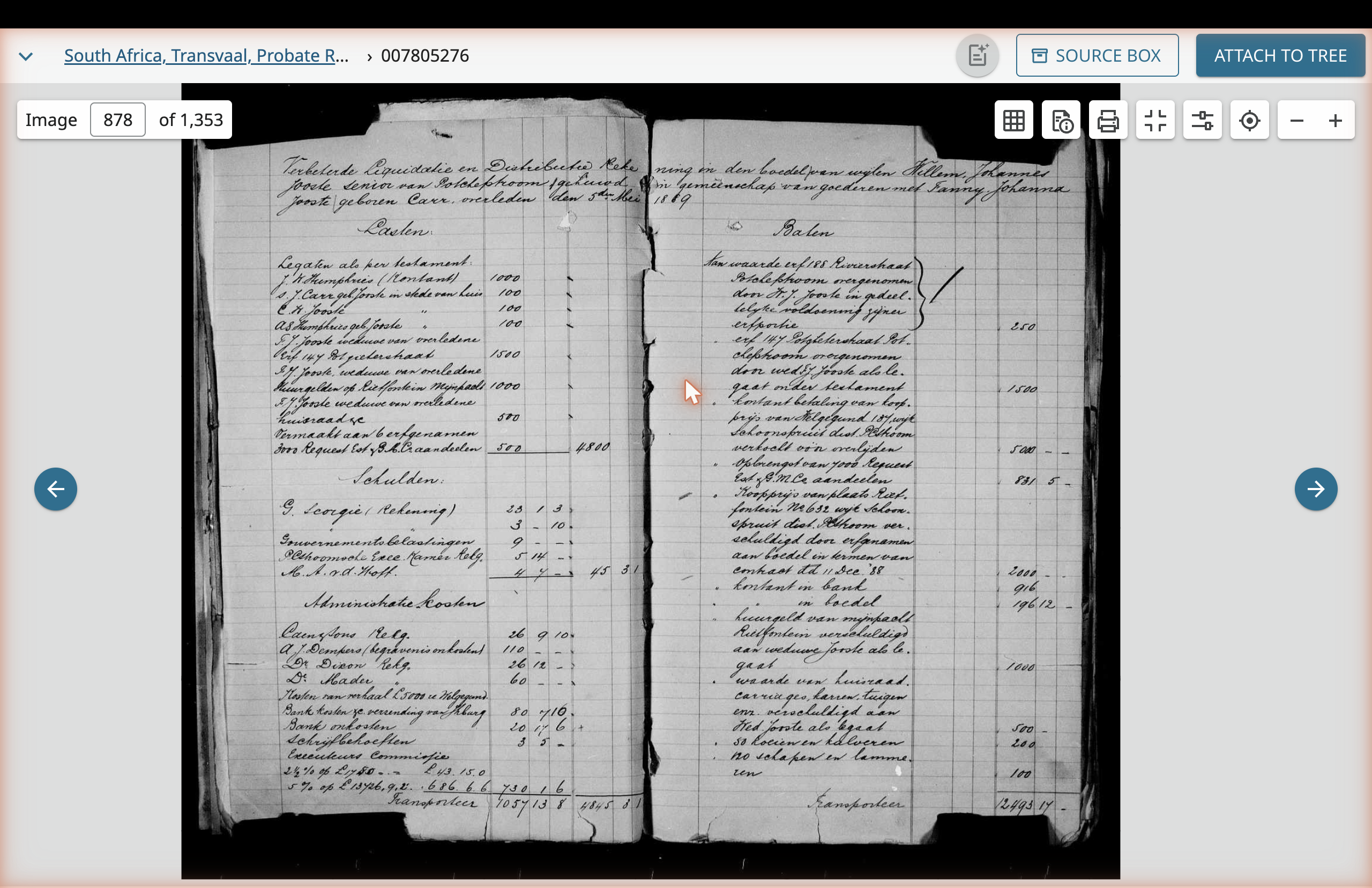
The First L&D Account opening, image 878. Lasten (Liabilities) on the left column, Baten (Assets) on the right column.
Image 878 The First L&D Account. Lasten (Liabilities, left column) and Baten (Assets, right column) reconciled to a Balans of £14,499 12s 6d. Filed approximately five and a half months after the Inventaris — fast by Transvaal probate norms, consistent with the remarriage-trigger preparation underway.

The numerical chain

From the gross Inventaris total to the Final Balans, the numbers reconcile through three stages:

StageDocumentAmount (£)What happens
1 Inventaris gross total · Image 877 22,316 All farms + shares + lending + receivables + domestic at gross valuation
2 Lasten subtotal · Image 878 left ~7,818 Testament legacies (£4,800: £1,500 widow's overlevenden + £1,000 Humphries grandchild + £100 each compensation to siblings) + Schulden (£3,018: secured bonds + family debts + outstanding accounts)
3 First L&D Balans · Image 879 left 14,499 12s 6d The net main-estate amount available for community-half + 8-way distribution
4 First L&D Distribution · Image 879 right 10,201 13s 5d Widow community-half £5,100 16s 9d + 8 children × £637 12s. The difference from Balans (~£4,298) is the supplementary 9-share allocation held separately per the Will's §3 clause.
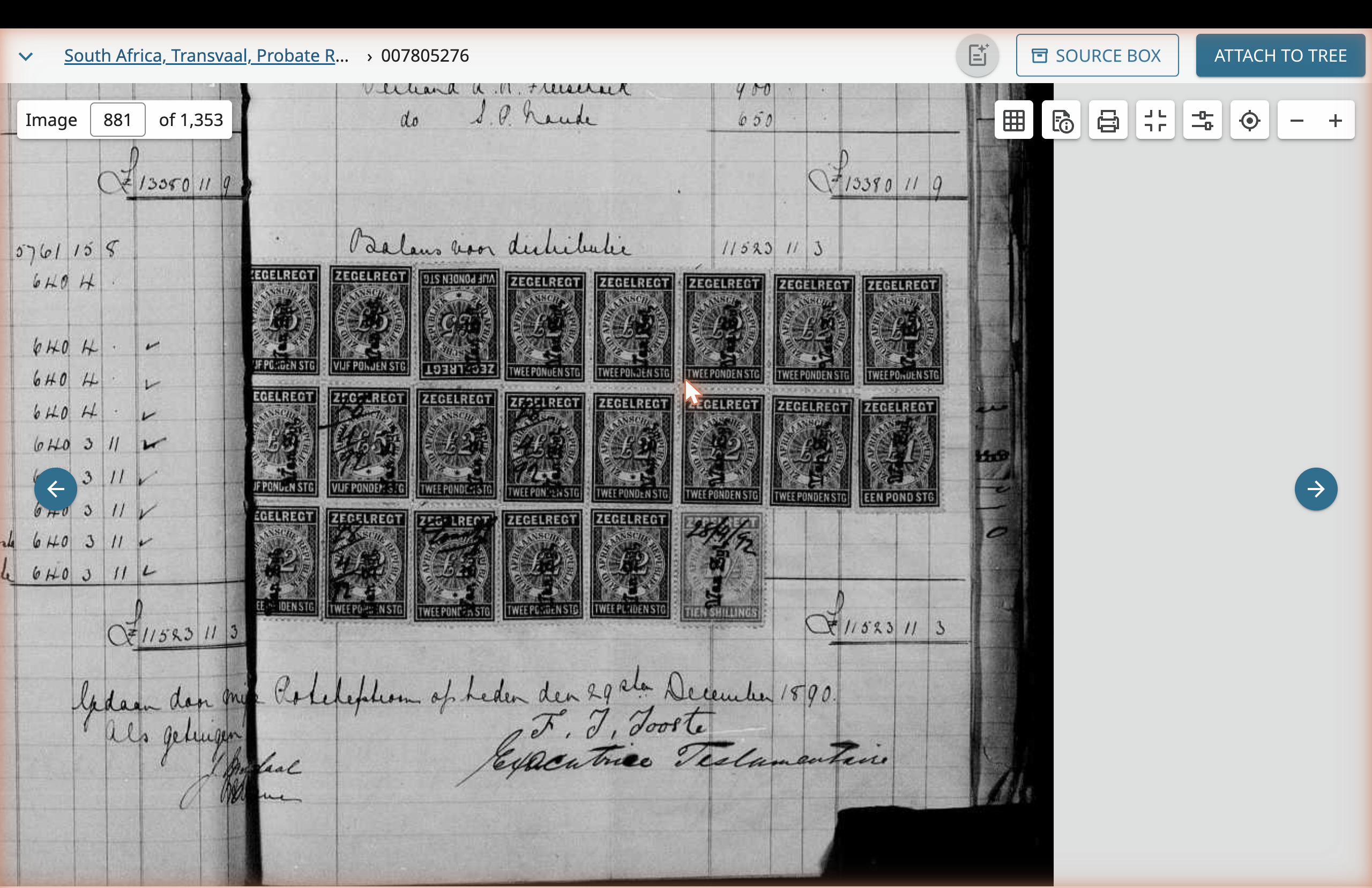
5 Final L&D Balans voor distribusie · Image 881 11,583 11s 3d Post-Weeskamer-Remarriage-Certificate Final Distribution: widow community-half upward-adjusted to £5,761 13s 8d; children at £640 4s each. The remarriage trigger required new settlement of community-half + supplementary rights.

The two L&D Accounts — 26 October 1889 first, 29 December 1890 final — bracket the activation of the remarriage-trigger clause and its consequences.

VI · Instrument V — The Final L&D + The Geldenhuys Trigger

Potchefstroom · 29 December 1890

The Final L&D Account closing page, image 881. Revenue stamps from the Z.A. Republiek mark the final Balans voor distribusie at £11,583 11s 3d.
Image 881 The Final L&D Account close. Z.A. Republiek revenue stamps cover the right side of the page — a block of eighteen one-pound stamps marking the duty paid on the £11,583 11s 3d Balans. The closing signature: "F.J. Joost", with executor declaration. At image 879's bottom-right column, the Geldenhuys signature appears: "F.J. Geldenhuys gebooren Carr Executrice" — the widow had remarried twelve days before the L&D close.

The 12-day window

Between 17 December 1890 and 29 December 1890, three events compress into twelve days:

17 December 1890
The Weeskamer Remarriage Permission Certificate is issued from the Weeskamerkantoor at Pretoria, Z.A. Republiek. The Certificate confirms that Frances Johanna Joost gebooren Carr, widow of the late Willem Johannes Jooste, may remarry without legal objection — the executor process had cleared. The signing officer's seal is visible at image 883.
~18–28 December 1890
Fanny's remarriage to a Geldenhuys takes place during this window. The exact date and the specific Geldenhuys spouse are not in the MHG file (the Weeskamer Certificate is the permission instrument; the marriage itself would be at a separate civil or parish register). The Geldenhuys family on the Cape side traces to Cornelis Geldenhuys born c. 1659 — a substantial Cape-side stamouer line. Research on the specific Geldenhuys spouse and marriage venue is opportunity OPP-260 in the pipeline.
29 December 1890
The Final L&D Account closes. Fanny signs as "F.J. Geldenhuys gebooren Carr Executrice" — using her new married name. The Will's §2 remarriage-trigger has activated; the estate is settled finally under the new community-half settlement; the 9-share supplementary rights continue as the testators' provision intended.

The nineteen-month total administration — from May 1889 Sterfkennisgewing to December 1890 Final L&D close — is rapid for a Transvaal probate of this size. Ordinary administration runs 12 to 24 months. The compression here is the trigger doing its work: the Will's clause forced a faster settlement once the remarriage was contemplated, and Fanny + her co-executors moved the file accordingly.

VII · The Rietfontein No. 632 Sale

1 December 1888 · Schoonspruit, Potchefstroom · Eight children, in shares

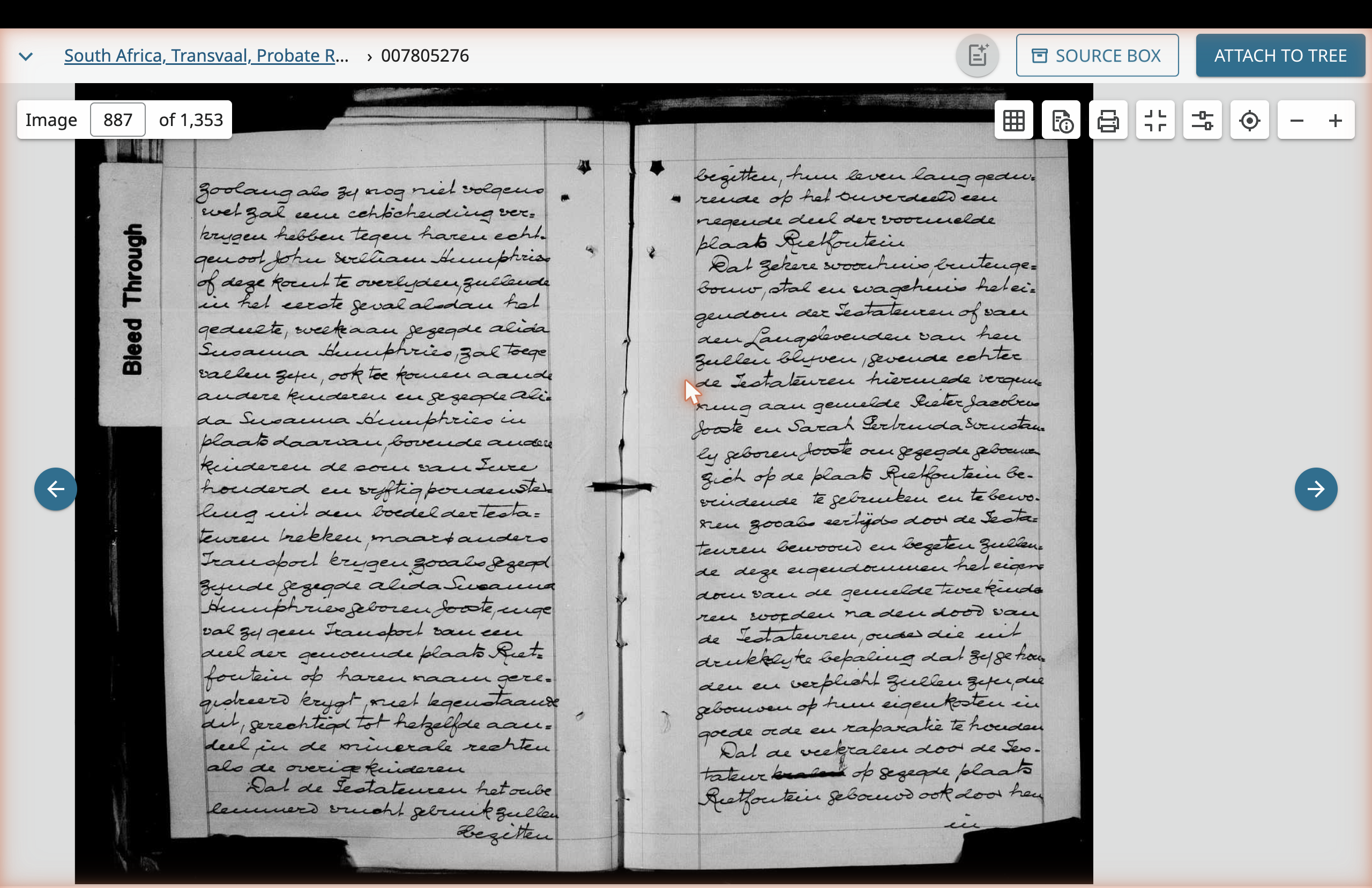
The duplicate Will body at image 887, showing the buyer-children listing for the 1 December 1888 Rietfontein No. 632 sale.
Image 887 — duplicate Will The buyer-children listing for the Rietfontein No. 632 sale. The duplicate Will at images 885–890 was bound into the file after the close of the Final L&D — likely attested by a notary in 1894 (the date appears at image 883) as a true copy of the Worcester No. 472 original. The duplicate's role at the file is cross-validation, and indeed it caught a substantive misreading of the original Will's §4 clause.

The sale at primary source

From the duplicate Will, image 887: "De Testateuren verklaren verder dat op den 1sten December 1888 de plaats Rietfontein No 632 gelegen in de wijk Schoonspruit district Potchefstroom door hen is verkocht in termen alsoo is overeengekomen, aan hun kinderen met name: Willem Johannes Joost (Jr) — Carl Willem Joost — Jacobus Petrus Joost — Robert Johannes Joost — Pieter Jacobus Joost — Alida Susanna Humphries gebooren Joost — Susanna Johanna Carr gebooren Joost — Sarah Gertruida Winstanley gebooren Joost."

Eight children, named at primary source by their married surnames, named co-buyers of the family's principal Potchefstroom-district farm — five months before G5's death and on terms the testators set themselves. The transaction precedes a private deed at Klerksdorp on 20 October 1888 (24 October per the duplicate Will). The timing is consistent with G5 settling the family's principal land asset onto the next generation in anticipation of his own death — and using the same instrument to establish the £1,000 trust for the Humphries grandchild and to set G4's eventual trustee role over that trust.

What the misread cost — and what corrected it

Earlier readings of the original Will at image 876 inferred a sale of Hartebeesfontein No. 590 to a son-in-law Hartzhof. That reading propagated into the project's §3.3 Land Arc model — which made the further inference that G4's eventual 1/8 share of Hartebeesfontein No. 590 at his 1906 estate had come through this Hartzhof son-in-law route. None of that is supported by the primary source. The duplicate Will at images 885–890 cross-validates the correct reading. The farm is Rietfontein No. 632. The buyers are eight children. There is no Hartzhof son-in-law in the buyer list. (A J.B. Hartzhof appears later in the file as a witness at the duplicate Will closing — distinct from any buyer or son-in-law role.) G4's 1906 Hartebeesfontein No. 590 1/8 share has a separate chain — not yet documented in SRC-2026-035; research opportunity OPP-259 (Klerksdorp Deeds Office title-chain).

Mineral rights preserved

The sale recital preserves mineral rights at equal share for all eight children. At the Klerksdorp gold-rush peak — 1886–1890 — this was a material consideration. The Potchefstroom Mining-Syndicate, Polchefstroom Steam Fields Co, Hardbreed Union, Norigskool Cabuon, and Vaalrivier — five companies G5 held shares in — were all operating in the same Vaal corridor where Rietfontein, Wilgespruit, and the other family farms sat. The eight children's reserved mineral rights at Rietfontein were a continuing economic interest, not a paper formality.

VIII · Instrument VIII — The Duplicate Will

Bound into the file · attested as a true copy · images 884–890

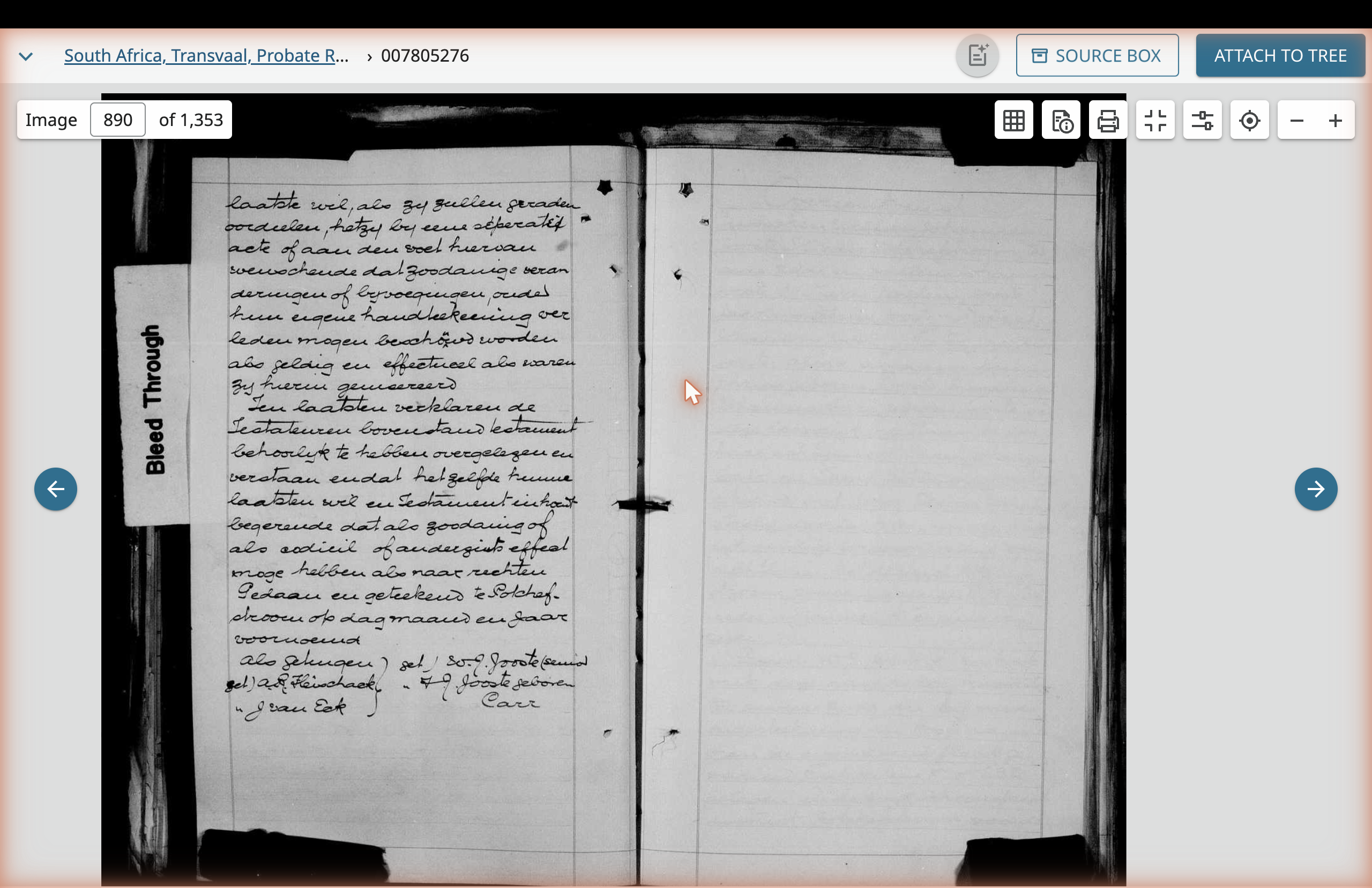
The duplicate Will closing signatures, image 890. The signatures of G5, Fanny, and the witnesses A.K. Hisenbach and J. van Eck are visible at the bottom.
Image 890 The duplicate Will's closing. The signatures: "Wilm. J. Joost sr", "F.J. Joost gebooren Carr", witnesses "A.K. Hisenbach" and "J. van Eck". The handwriting matches the original Will at image 877 — both are in the same Cape-Dutch cursive of the 1880s. The presence of the duplicate in the Master's file is unusual but not unique; it suggests either family precaution (the duplicate was kept by the family at home and notarised later for the Master's record) or executor caution (a second copy was prepared during the rapid administration to ensure no clause-reading dispute could arise).

What the duplicate disclosed

The duplicate Will at images 884–890 is the cross-validation instrument for the original Will at images 873–877. It is what caught the Rietfontein-vs-Hartebeesfontein misread. It also documented several substrate points the original alone did not make clear:

IX · The Family — Three Generations Visible

G6, G5, G4: parents named at primary source for the first time

The G5 1889 file is the first document in the project's primary-source substrate to name G6 — Willem Johannes Sr's parents — at primary source. The Sterfkennisgewing's field 3 (Namen der Ouders van den Overledene) records them in Fanny Carr's hand on the day of G5's death. The xlsx family-tradition reading was wrong at G6 generation; the primary source corrects it.

G6 — Father
Jacobus Petrus Jooste
Born before 31 July 1785, Land van Waveren (Cape Colony). Likely a farmer on the Cape side at G6 generation. Cross-references to canonical Cape DRC baptism records are pending at iter 6 of the project's research cascade. The xlsx-tradition reading of "Pieter Cornelis Jooste bap. 4 Oct 1789 Tulbagh" was wrong — and stands corrected at primary source by his son's 1889 death notice.
G6 — Mother
Alida Susanna Theron
Born 10 May 1793 (per WikiTree corroboration). Of the Theron family, a substantial Cape-Huguenot line traceable to Jacques Theron of Vienne, Dauphiné, France. The Theron carrier-link at G6 brings the project's first Huguenot connection forward from the G9 Maria Mouton 1706 marriage; the Mouton + Theron lines together make two of the Cape-Huguenot pillars at the lineage.
G5
Willem Johannes Jooste Sr
30 May 1828 (Tulbach, Cape Colony) — 5 May 1889 (Potchefstroom, Z.A. Republiek). Particulier. The generation at which the family wealth crystallises from farmer ancestry into diversified portfolio. The G5 1889 file is his.
G5's wife · G4's mother
Frances Johanna Carr → Joost → Geldenhuys
Of the Carr family — Cape-Dutch by way of Worcester (the Carr family research is opportunity OPP-261). Married G5 (community of property, date undocumented in this file); widowed 5 May 1889; remarried into the Geldenhuys family between 17 December and 29 December 1890; died c. 1905. The widow at the Sterfkennisgewing; the Executrix at the First L&D; the Geldenhuys-renamed Executrice at the Final L&D.
G4 — G5's eldest son
Willem Johannes Jooste Jr
2 May 1856 — 16 January 1906, Braamfontein. The bridge from G5 to G3. Co-executor of G5's estate; co-buyer of Rietfontein No. 632 1888; trustee-designate for the Humphries grandchild bequest; took Bischelfsdrad farm from G5's estate at the distribution. His own MHG file is at SRC-2026-034 (G4 1906 Heritage Card, deployed at jooste-1906-estate.pages.dev).

Carriers — what the marriages brought in

The G5 family carriers across generation are:

X · Provenance & Methodology

How this reconstruction was made

Source

The G5 1889 MHG file is held at the TAB Transvaal Archives Depot within the National Archives of South Africa (NARSSA) in Pretoria. It forms part of the Master of the Supreme Court of the Transvaal — Probate Estate Case Files 1869–1961 collection (FamilySearch collection 2520237). The file occupies images 872–891 of the microfilm-scanned volume 007805276, Item 5, titled "Transvaal. Probate Estate Case Files 1889". The case reference at the file spine is 4602/89.

The volume is accessible via FamilySearch at the image-viewer ARK 3:1:3Q9M-CS92-69G6-7. The personArk for G5 indexed metadata is 1:1:Q2DG-RCXL. Access requires a FamilySearch account; the file viewer requires authenticated session.

Method

85 captures of the file were made at full Retina resolution (2560×1656) by the founder using macOS Cmd+Shift+4 selection screenshots from the FamilySearch image-viewer. Coverage spans images 872–891 — Sterfkennisgewing, full Joint Will, Inventaris, both L&D Accounts, Power of Attorney, Weeskamer Remarriage Certificate, duplicate Will, and file-close spine.

The captures were transferred to the canonical SRC-2026-035 source directory and renamed by FamilySearch image-number (the original chronological-capture-order naming had drifted from FS image-numbers across the 20 images; the rename pass at iter 4 phase 3 corrected the naming convention to match FS image-numbers).

The Hollands cursive transcription was made jointly: the agent transcribed at cursive-vision tier; the founder verified at full-Retina view where readings were uncertain. Several substantive readings — Rietfontein vs Hartebeesfontein, the 9-share supplementary clause interpretation, the witness identification at the duplicate Will, the children's married surnames — were resolved through cross-validation between the original Will and the duplicate Will bound in the same file. Where reading uncertainty remains, [bracketed annotations] mark the substrate-uncertainty register.

Reconstruction at substrate-citation depth

The full reconstruction is published as source.md at SRC-2026-035 in the project's canonical source-storage — approximately 6,000 lines of Hollands-to-English transcription, analytic substrate, cross-validation, and honest caveats. The directory: /heraldry/60_research/sources/items/SRC-2026-035/. The page-images are at SRC-2026-035/page-images/, renamed per FS image-number with sequential cap-numbering within each image bucket.

Architectural altitude

The G5 file is the deepest single-source primary substrate the project has engaged at any generation — substantially deeper than the G4 1906 file in single-source coverage (~6,000 lines of source.md against G4's ~900). The Asset Arc inflection visible in this file — the transition from farmer-G6 ancestry to diversified-portfolio Particulier — is the generation at which the family wealth crystallises. Combined with the G4 1906 file at SRC-2026-034 + the G9 1714 Cape MOOC + the G9 1706 Bartolomeusklip first-asset amassed at the Mouton marriage, the project now has primary-source substrate at four generations across two centuries of Cape-and-Transvaal history.

For the wider campaign — the heritage atlas across the full Joost lineage — see the Heritage Atlas at /atlas/ when deployed. The first Heritage Card in the register is at jooste-1906-estate.pages.dev (G4 1906). The full project substrate is at /heraldry in the Jooste portfolio repository.

← Previous in register G6 · 1810s Pending Cape DRC engagement ↑ Register Heritage Atlas Two hundred and ninety years Next in register → G4 · 1906 Willem Johannes Jooste Jr · Braamfontein